
Last updated
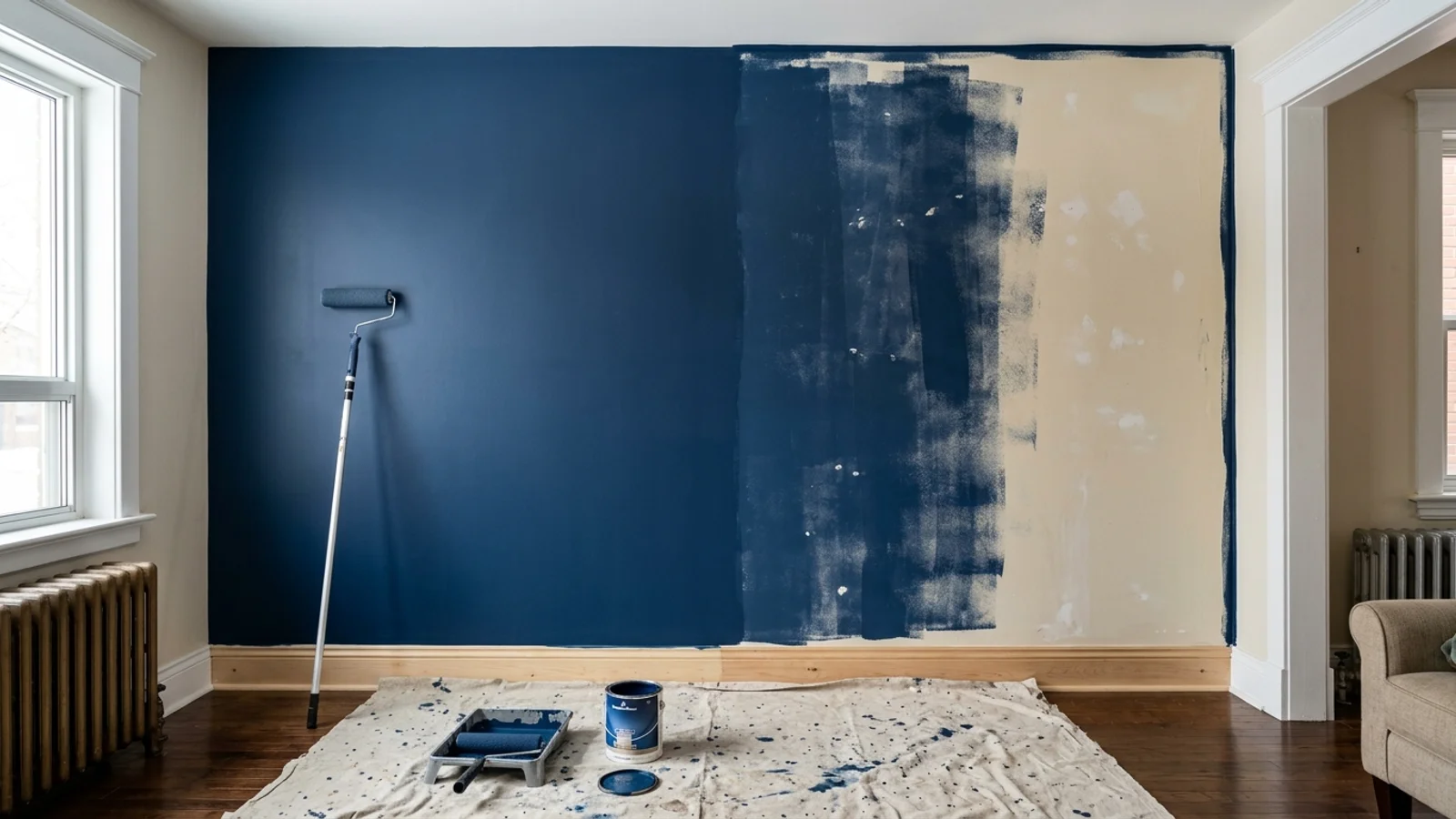
Most walls need 2 coats of finish paint. The first coat covers; the second evens out the colour and sheen and builds the film thickness the product was made for. New drywall, patches and stains need primer first, and big colour changes or deep reds and yellows may need a third coat.
Why is two coats the standard for walls?
Two coats give an even colour, an even sheen and a paint film thick enough to wear well. One coat rolled at the label's spread rate usually leaves thin spots and patchy sheen. Paint makers agree: Benjamin Moore's data sheet for Regal Select says one coat sometimes covers, but it recommends two for full colour and the best performance.
Each coat goes on thin. A typical wall-paint data sheet calls for about 4 mils wet, which dries to about 1.6 mils. A mil is a thousandth of an inch, so that dry coat is less than half as thick as a sheet of printer paper. The second coat doubles the film and fills the gaps the first coat missed.
What the second coat fixes:
- Thin spots where the old colour or the primer shows through
- Brushed edges that look different from the rolled wall
- Colour that looks lighter or blotchier than the chip
- A film too thin to stand up to regular wiping
Holiday:
a missed or thin spot in a coat of paint, where the surface underneath shows through.
Wait for the recoat time on the can between coats. Our guide to how long paint takes to dry and cure lists typical times.
Is one coat of paint ever enough?
One coat can be enough in a few narrow cases. A same-colour refresh over clean, sound paint may look fine, and so can a touch-up from the original can. Most repaints still look better with two.
One coat works only when the old paint is in good shape, the colour barely changes and the new coat goes on at full thickness. A closet or a storage room is a fair place to try it. A living room with side light from big windows will usually show the difference.
What does "one-coat" mean on the label?
"One-coat" is a claim for ideal conditions, not a promise for every wall. The fine print usually limits it to certain colours, a clean and properly prepared surface, and paint applied at the full spread rate. One large brand, for example, applies its one-coat claim only to colours from a set collection. It adds that bare, porous, patched or heavily stained surfaces may need spot-priming or more coats.
When do walls need primer before painting?
Walls need primer when the surface is new, patched, stained or glossy, or when the colour change is large. Primer is not a finish coat. It seals the surface and helps paint grip, so the two finish coats go on evenly.
The common cases in GTA homes:
- New drywall in a finished basement or an addition
- Patched nail pops, cracks and holes
- Water stains from an old leak or ice dam, and smoke stains
- Glossy or oil-based trim you plan to cover with latex
- A big jump, such as charcoal to white
Some premium paints are rated to prime new drywall themselves, if you apply two coats. Check the data sheet before you count on it. Our guide on whether you need primer before painting covers each surface.
When do you need a third coat?
A third coat is most often needed for deep, bright colours, and for big colour changes made without a tinted primer. Many bold reds, oranges and yellows are fairly transparent, so they build colour slowly. A tinted primer under them often saves that third coat.
Sherwin-Williams, for example, codes many deep colours from P1 to P6, the shade of grey primer that brings them to their true colour in fewer coats. Benjamin Moore's data sheets say to tint the primer toward the finish colour when the change is large.
| Situation | Typical system |
|---|---|
| Same colour over sound paint | 1 or 2 coats |
| New colour of a similar depth | 2 coats |
| Light to dark, or dark to light | Tinted primer, then 2 coats |
| Deep reds, oranges and yellows | Grey or tinted primer, then 2 or 3 coats |
| New drywall | Drywall primer, then 2 coats |
| Patched spots | Spot primer, then 2 coats |
| Water, smoke or marker stains | Stain-blocking primer, then 2 coats |
How much paint do two coats take?
Premium wall paints typically list 350 to 450 square feet per coat from a US gallon, about 3.8 litres, on a smooth, sealed wall. Two coats need twice the paint. Rough, porous or patched walls drink more.
Take a 12-by-12-foot bedroom with 8-foot ceilings. Its walls measure about 380 square feet before you take out a door and a window. Two coats come to roughly 700 square feet, or about 2 gallons. The ceiling is extra.
Buy enough for the whole room at once, and keep the leftover can, labelled with the room. Paint from the same batch touches up best.
Boxing:
mixing several cans of the same colour together before painting, so small differences between cans don't show on the wall.
How can you tell if a wall needs another coat?
Check the wall once it is fully dry, because paint shifts in colour and sheen as it dries. Look in daylight, then hold a lamp close to the wall so the light skims across it. Thin spots, streaks and uneven edges show up quickly that way.
Walk the room in this order:
- Scan each wall from a few steps back for shadows of the old colour.
- Look along the ceiling line, corners and trim for a band that looks different.
- Check patched spots for dull or shiny patches.
- Look at the wall at a low angle for streaks and roller lines.
Hatbanding:
a band along the ceiling, corners or trim where the brushed edge looks darker or different from the rolled wall.
If you see hatbanding or holidays after two coats, a third coat rolled close to the edges usually evens them out. If patches show through as dull spots, they needed primer first. Spot-prime them, then recoat the wall.
What does a two-coat paint job cost in the GTA?
Every Great North price includes two coats of the paint named in your quote, along with the prep. For interior painting, a bedroom's walls start
from $450, and a whole 3-bedroom home runs $4,800–$9,500, before HST. A room booked on its own is billed at no less than the $750 + HST minimum.
A big colour change is one of the things that moves a job within its range. See what it costs to paint a room in Toronto or the interior painting cost guide for the detail. For a price range on your own rooms, start with Get My Estimate.