

Last updated
A colour consultation is a working session, best held in your own home. You walk the rooms and look at the floors, counters and furniture that are staying. Each space is narrowed to 2 or 3 colours, tested in its own light. You should leave with a brand, colour code and sheen for each surface.
What happens during a colour consultation?
You and the consultant walk the rooms and settle a colour, a sheen and a code for each surface. Most of the time is spent looking: at your floors, your light and colours held against your walls. A typical consult runs in this order:
- Agree on the scope. Which rooms, and which surfaces: walls, ceilings, trim, doors, any accent wall.
- Note what's staying. Floors, counters, tile, a brick fireplace, oak stairs, big furniture. Paint comes in thousands of colours and these don't, so the paint is chosen to suit them.
- Talk about the look. Bring photos of rooms you like, and name the colours you already dislike.
- Read the light. Which way the windows face, and which bulbs light each room at night.
- Narrow the field. Each space gets 2 or 3 candidates, held against the finishes that stay.
- Plan the flow. Rooms that open onto each other need colours that sit well together, or one colour carried through.
- Pick the sheens. Usually flat for ceilings, a low sheen for walls and a harder finish for trim and doors.
- Write it down. Brand, colour name, code and sheen, room by room.
A good consult ends with fewer choices than it started with. The last word often goes to the samples.
How should you prepare for a colour consultation?
Know what you're painting, and bring samples of what's staying. A little homework lets a short consult settle more rooms. Have these ready:
- A list of rooms and surfaces, including ceilings, trim and doors.
- Pieces of what stays, if you have them: a spare floorboard, a cabinet door, a tile or countertop sample.
- Saved photos of rooms you like, and a note of colours you don't.
- The codes of any colours you're keeping, from old cans or receipts.
- Working bulbs of one colour temperature in each room.
In a condo, ask management whether the corridor side of your unit door must stay the building's colour. For an exterior, plan around the roof, the brick or stone and the window frames.
How does light change the way a paint colour looks?
Light decides how pale or deep a colour reads, and which undertone comes forward. The same paint can look warm at noon and grey at dusk. Your windows set the daylight, and your bulbs take over at night.
The direction a room faces matters most:
| Windows face | The daylight | What it does to colour |
|---|---|---|
| North | The least light: soft, even and cool | Colours look cooler and more muted |
| South | Bright and warm for most of the day | Colours look warmer, and very warm ones can look strong |
| East | Warm in the morning, cooler later | Colours shift from warm to cool through the day |
| West | Cool in the morning, warm late in the day | Colours shift from cool to warm through the day |
Sherwin-Williams suggests warmer colours for north-facing rooms. For east- and west-facing rooms, choose for the hours you use the room most.
GTA homes add their own cases. A north-facing condo gets cool, even light through big windows. In a Toronto semi or row house, the middle rooms may get little daylight, so lamps decide the colour there. Basements often run almost entirely on bulbs.
Seasons matter too. Benjamin Moore notes that winter daylight tends to be cooler and sharper than summer light. A colour chosen on a grey January day can look warmer in July. If you're painting in the cold months, see painting your interior in winter.
Colour temperature:
how warm or cool a light looks, measured in kelvins (K); lower numbers look warmer, higher numbers cooler.
Bulbs around 2700K to 3000K give a warm, yellowish light. Bulbs around 5000K look cool and bluish. Keep one colour temperature per room, and judge samples under the bulbs you'll use. Bulbs with a colour rendering index (CRI) of 90 or higher show colours more faithfully.
Light reflectance value (LRV):
how much light a colour reflects, on a scale from 0 for black to 100 for pure white.
Benjamin Moore and Sherwin-Williams list it for each colour online. Benjamin Moore's White Dove (OC-17) is about 83, and Sherwin-Williams' Alabaster (SW 7008) about 82. In a dim room, a higher LRV keeps the space brighter.
What are undertones, and how do you spot them?
An undertone is the faint second colour inside a neutral: the green in a grey, the pink in a beige, the yellow in a white. It hides on a small chip and shows across a whole room. You find it by comparison.
Undertone:
the subtle second hue that sets a colour apart from similar ones, such as the blue in a cool grey.
Three checks help:
- Against white. Hold the chip on plain white paper in daylight, as Benjamin Moore suggests. The paper also keeps your current wall colour from swaying you.
- Side by side. Line up 3 or 4 similar colours, and the differences jump out.
- Down the strip. Look at the deeper colours on the same paint strip, where the undertone is easier to see.
Greys can turn blue, green or violet. Beiges can lean pink or green, and whites can read yellow, blue or grey. What stays in the room matters too: orange-toned oak floors or stairs can make a cool grey look bluer. So hold every candidate against the floor and counters, not just the wall.
The painting glossary explains other terms you'll hear, such as sheen, hide and tint base.
How do you test paint samples before you commit?
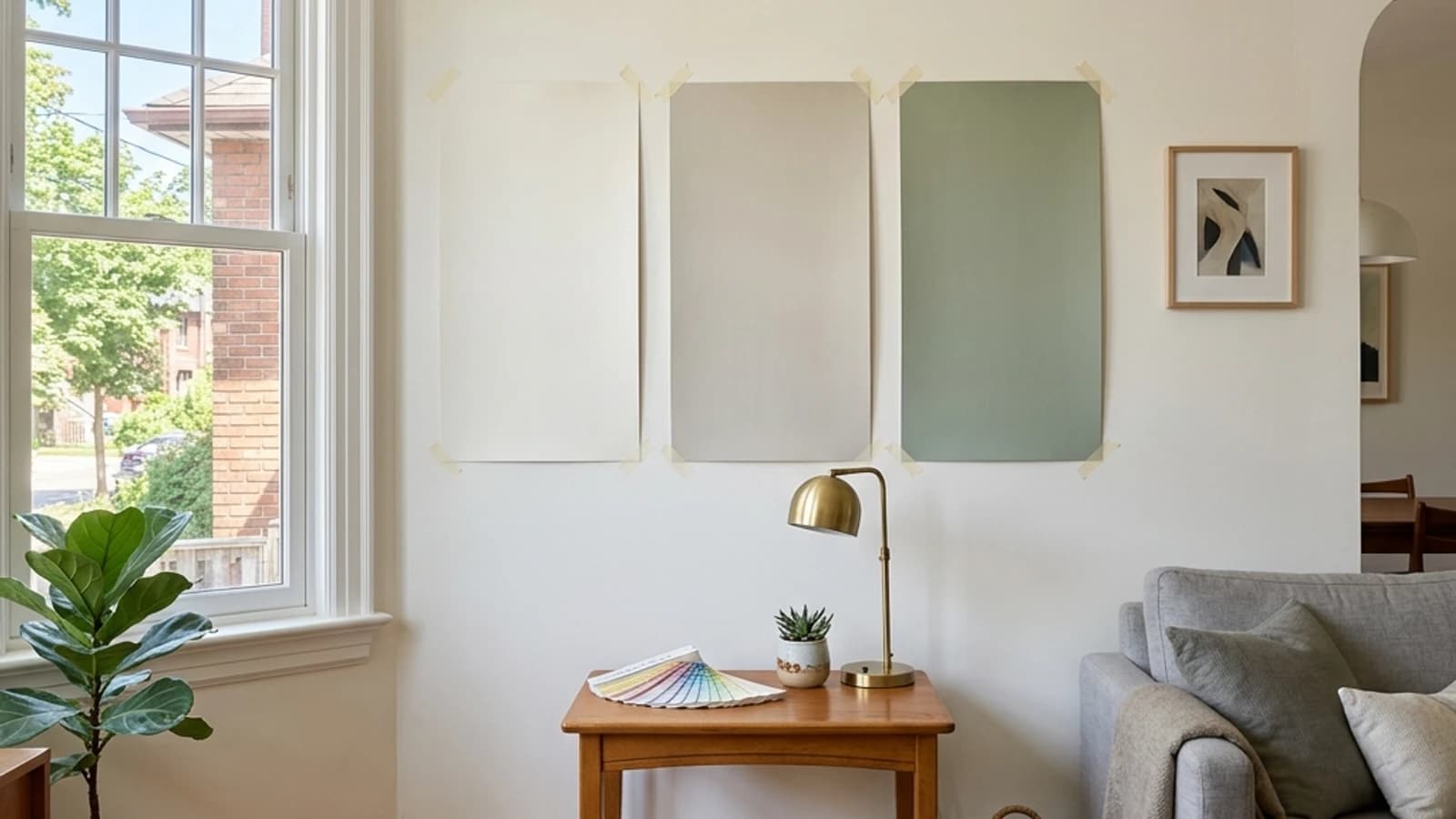
Paint large samples in two coats, and look at them at several times of day. A small chip can't show how a colour behaves across a wall. Give your finalists two or three days.
- Get a sample pot or a large peel-and-stick sample of each finalist. A 236 mL Benjamin Moore sample pot covers about 60 by 60 cm (2 by 2 feet) in two coats.
- Brush two coats onto white foam board, or onto the wall if it's white or a light neutral. Benjamin Moore suggests either, and a board can move around.
- Try each sample on the brightest wall and in the darkest corner, beside the trim and near the floor.
- Hold chips and boards upright against the wall, not flat on a table.
- Look in the morning, at midday and at night with the lamps on.
Don't decide from phone photos. Cameras adjust colour on their own, so photos mislead.
Benjamin Moore's sample pots come in an eggshell finish. The same colour in a flat ceiling paint or a semi-gloss enamel can look slightly different. The paint sheen guide covers which sheen suits each surface.
How do your colour choices carry into the quote?
They become part of the written paint spec. For each surface, the quote or contract should name the brand, product line, colour and code, and sheen. If colours change after you sign, get the change in writing.
Codes matter more than names, because names repeat across brands. Benjamin Moore and Behr both sell a white called Swiss Coffee, and they are different colours. A store can match another brand's colour, but only closely: each maker uses its own bases and colourants. Sample a match before the whole job is mixed.
Here is a sample colour schedule for a main floor. The colours show the format, not a recommendation.
| Room | Surface | Brand, colour and code | Sheen |
|---|---|---|---|
| Living and dining | Walls | Benjamin Moore Revere Pewter, HC-172 | Eggshell |
| Living and dining | Ceilings | Benjamin Moore White Dove, OC-17 | Flat |
| Whole floor | Trim and doors | Benjamin Moore White Dove, OC-17 | Semi-gloss |
| Front hall | Walls | Sherwin-Williams Agreeable Gray, SW 7029 | Satin |
Colour can change the price. Covering a dark wall, or rolling on a deep red, may need a tinted primer or a third coat. Settle colours before the quote is final, or ask how a change affects it. See how many coats of paint walls need.
Keep the schedule with your house papers, and label leftover cans with the room and code. The guide to what a painting quote should include covers the other lines.
Is a colour consultation free, and how do you book one?
It depends on who offers it, so ask about the terms first. At Great North, a 30-minute colour consultation with a crew lead is free on painting projects over $2,500. You leave with Benjamin Moore and Sherwin-Williams colour codes for the rooms or walls you're painting.
For scale, a whole 3-bedroom interior runs $4,800–$9,500 before HST, well over that threshold. A single room usually falls under it, so grouping rooms into one project can bring the consult with it.
Colours come up before your quote, too. A crew lead checks your photos for repairs and talks through colours and timing with you. Your written quote follows within 24 hours of seeing the job and names the paint by brand and line.
Ask for the consult when you text photos or call for your quote. For a price range first, use Get My Estimate. See colour consultation and interior painting for what's included, and the interior painting cost guide for prices by room.