

Last updated
Painting inside your own unit rarely needs board approval, but the building sets the rules for how the work happens. Toronto condos typically ask for notice to management, a booked service elevator, work inside set contractor hours and a certificate of insurance from your painter. Ask management for its forms 2 weeks before you want to start.
Do you need condo board approval to paint your unit?
Usually not, for the inside of your own unit. Painting your walls and ceilings is normally your choice. The building's rules still control how the work gets done, and anything outside your unit needs permission first.
Where your unit ends is set out in the condo's declaration. Everything beyond that line is a common element.
Common elements:
the parts of a condominium outside the units, such as corridors, the lobby, the exterior walls and balconies, owned by all the unit owners together.
Changing a common element needs the board's approval first. Section 98 of Ontario's Condominium Act, 1998 sets out when an owner also needs a written agreement with the corporation. The board can also make rules under the Act about how units and common elements are used. Those rules are where contractor hours, elevator bookings and noise limits live.
If you rent your condo, get the owner's written permission before you paint.
What paperwork does condo management usually ask for?
Expect a short form and a couple of documents. Buildings want to know who is coming, when, and what they will do. They also want proof that the contractor carries liability insurance. Management or the concierge can give you your building's own list.
| Item | What it is | Who provides it |
|---|---|---|
| Renovation or contractor notice | A form with your unit, the company, the dates and the work | You, with your painter's details |
| Certificate of insurance | Proof of the contractor's liability coverage, its limits and its dates | Your painter's insurer or broker |
| WSIB clearance certificate | Proof the company is registered with the WSIB and up to date | Your painter, from the WSIB |
| Elevator booking | A reserved time on the service elevator | You or your painter, through management |
| Parking or loading dock booking | A place for the crew to stop and unload | You or your painter, through management or security |
Certificate of insurance:
a one-page document from a contractor's insurer or broker that confirms their liability coverage, its limits and the dates it runs.
Some buildings ask to be named on the certificate as an additional insured. Get the corporation's full legal name from management and pass it to your painter early. A WSIB clearance is valid for up to 90 days, so ask for a current one. The guide to choosing a house painter in Toronto covers what to check on both documents.
How do elevator bookings work for painters?
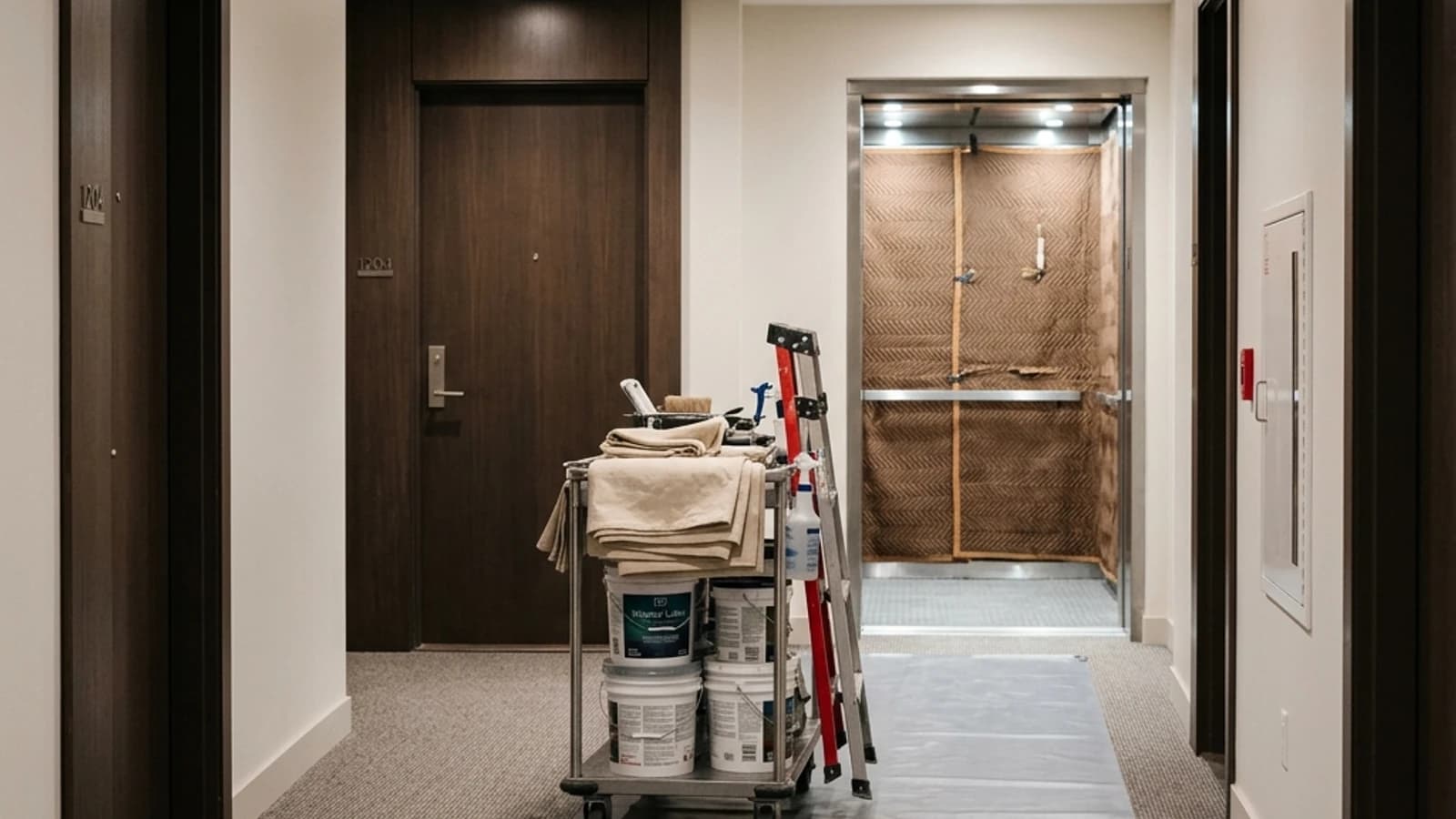
You or your painter reserve the service elevator for a set time, through management or the concierge. The crew brings ladders, drop cloths and paint up during that slot. Book early, because move-ins and other trades want the same slots.
A few habits make bookings easier:
- Avoid the last and first days of the month if you can, when moves tend to fill the calendar.
- On a job of more than one day, ask whether the crew can leave equipment in the unit overnight. Then the first and last days are the ones that need the elevator most.
- Ask whether trades must use the service elevator at all times, even when carrying small items.
- Ask where the crew can park. Many downtown buildings have little visitor parking, and the loading dock may need its own booking.
What hours can painters work in a Toronto condo?
Whatever your building's rules allow, and that is often narrower than the city's limits. Many buildings set contractor hours on weekdays and limit trades on weekends and holidays. Management can tell you your building's exact hours.
The City of Toronto's noise by-law sets the outer bounds. It bars clearly audible construction noise from 7 p.m. to 7 a.m., until 9 a.m. on Saturdays, and all day on Sundays and statutory holidays. A condo's own contractor hours usually sit inside that window.
Painting itself is quiet, but the prep isn't always. Moving furniture, scraping, patching and sanding can carry through concrete. Plan the noisy parts for the middle of the day, and slip a short note with your dates under your neighbours' doors.
What can't you paint in a condo without permission?
Anything outside your unit's boundaries. The corridor side of your door, the balcony and the building's exterior are the corporation's to manage, so ask first. Fire safety devices are stricter still: sprinkler heads, smoke alarms and heat detectors must never be painted, even inside your unit.
- The corridor side of your door and its frame. Many buildings keep hallway doors one colour, so ask before you paint them.
- Balconies and terraces. These are usually exclusive-use common elements.
- Windows, window frames and the exterior. These are usually common elements.
- Sprinkler heads, smoke alarms and heat detectors. Paint can delay or stop a sprinkler head from opening in a fire. A painted head has to be replaced, not cleaned. A careful painter cuts in around them by hand and keeps every drop off them.
Exclusive-use common element:
a part of the common elements, such as a balcony, that only one unit may use while the corporation keeps control of it.
One more check in older buildings. In a building from before about 1990, a textured or stipple ceiling may contain asbestos. Test it before anyone scrapes or sands it. See popcorn ceilings and asbestos in Ontario for how testing works.
How do you protect the building while your unit is painted?
Keep the work, the dust and the smell inside your unit. Keep your unit door closed, and never prop open a fire door to move equipment. Wipe up any drips in the corridor or elevator the same day.
Air the unit through its own windows or balcony door, and run the bathroom and kitchen fans. That keeps the smell out of the hallway.
Paint needs care on the way out, too. The City of Toronto says paint must not go in the garbage, the Blue Bin or Green Bin, or down a drain, toilet or sewer. Ask management where brushes and rollers can be cleaned. Keep a labelled can of each colour for touch-ups. Take the rest to a City Drop-Off Depot or a Community Environment Day.
How much does it cost to paint a condo in Toronto?
Condo painting in the GTA starts from $850 for a studio, before HST. The price rises with the unit's size, ceilings, repairs and colour changes.
| Scope | Price, before HST |
|---|---|
| Studio | From $850 |
| 1-bedroom | $1,100–$2,400 |
| 2-bedroom | $1,800–$3,800 |
| 3-bedroom | $2,400–$5,000 |
Prices are in CAD before HST and include every mandatory fee. Minimum job $750 + HST (one crew-day).
Every price includes prep and two coats of the paint named in your quote. The work carries a 5-year written workmanship warranty. On condo jobs, Great North arranges the elevator bookings with your building and keeps the work within its quiet hours. How many bookings you need depends on how long the job runs; see how long it takes to paint a house interior.
For a range in about a minute, use Get My Estimate. Your written, itemized quote arrives within 24 hours of seeing the job. See condo painting for what's included, and Toronto for the neighbourhoods we serve.